


COLORADO · UPDATED OCTOBER 2026

What Colorado funeral professionals need to know.

Colorado’s chain-of-custody requirements, the changes that start January 1, 2027, and a free guide and checklist, cited to the statute and rule.

Informational only — not legal advice.

A funeral professional holding a phone with the MorTrack dispatch app, in front of a Denver skyline and the Colorado state outline
Status
Full custody tracking requirement
Regulator
Colorado Division of Professions and Occupations (DORA)
Latest change
HB26-1258, signed June 4, 2026; key changes start January 1, 2027
Last verified
October 2026

REQUIRED TODAY

Positive identification and tracking from custody to release

These requirements apply to funeral establishments and crematories, and they run through the removal companies and trade services that act on their behalf.

  1. Before and at first custody

    1. Positive ID before custody

      No custody of human remains, whether taken by your own staff or by your contractors or agents, without an attestation of positive identification on the state’s form.

      C.R.S. 12-135-113(1); 12-135-308

  2. In transport

    1. Safe, sanitary and dignified

      Remains are transported in a way that is customary within the profession, safe, sanitary and dignified, and never stacked.

      C.R.S. 12-135-112(2)(b)

    2. Common carriers

      Transport or transfer by common carrier goes to a funeral establishment, funeral director, embalmer, cremationist or natural reductionist within Colorado, unless another exception applies.

      C.R.S. 12-135-105(1)(g)

  3. In your care

    1. Identify and track until release

      The establishment or crematory identifies and tracks remains from custody until final disposition, return to the person with the right of final disposition, or release to another establishment, crematory or authorized entity.

      C.R.S. 12-135-113(2); 12-135-308

    2. Refrigeration capacity

      No more unembalmed remains in custody than the establishment can refrigerate, unless they are held for less than 24 hours.

      C.R.S. 12-135-113(4)

    3. Your own procedures

      A firm may use its own identification and custody procedures if they meet or exceed the state’s minimum standards.

      C.R.S. 12-135-113(3)

  4. At release and on record

    1. Custody records

      A completed custody record for all remains received and released, positive identification of the decedent, and an attestation of release authorization.

      4 CCR 742-1 (eff. January 15, 2025)

    2. Annual inspections

      Routine inspections of all funeral establishments and crematories, at least once a year.

      C.R.S. 12-135-401(3)(a)(II)

    3. One registration, renewing now

      Funeral home and crematory registrations are now a single funeral establishment (FES) registration. All FES registrations expire November 30, 2026; renewal includes attesting to professional liability insurance of at least $1 million.

      C.R.S. 12-135-114

RECENT CHANGES

What changes on January 1, 2027

Colorado’s Mortuary Science Code was rebuilt by SB24-173 and HB24-1335 in 2024 and amended by HB26-1258, signed June 4, 2026. Four changes start on January 1, 2027. None of them creates a new custody rule.

  1. Individual licenses to practice

    Funeral directors, mortuary science practitioners, embalmers, cremationists and natural reductionists must hold an individual license. A provisional path for experienced practitioners is open now.

    C.R.S. Title 12, Art. 135 (SB24-173)

  2. A licensed designee for every establishment

    Each funeral establishment’s designee must be licensed as a funeral director or a mortuary science practitioner.

    C.R.S. 12-135-110(3) (HB26-1258)

  3. A new associate license

    Individuals can apply for an associate license to gain the practice experience needed for full licensure. It expires three years after it is issued.

    C.R.S. 12-135-501(7) (HB26-1258)

  4. A higher penalty for abuse of a corpse

    Offenses on or after January 1, 2027 are a Class 5 felony, up from Class 6. The definition includes transporting or storing a body in a degrading manner, including stacking.

    C.R.S. 18-13-101 (HB26-1258)

A smiling woman with curly hair and glasses, wearing a light grey blazer in an office

Who this applies to

Colorado’s custody duty sits with funeral establishments and crematories, and it runs through their contractors and agents, so it reaches every business that handles a case.

  • Funeral establishments

    From the positive-ID attestation before custody through final disposition or release.

  • Crematories

    A parallel duty to positively identify and track remains, from receipt through release.

  • Removal companies and trade services

    Work done on an establishment’s behalf is part of its custody record. Embalmers and cremationists need individual licenses from January 1, 2027.

Free Colorado guide and checklist

Colorado’s custody duty already applies, and its licensing changes start January 1, 2027. These free resources put the requirements in plain language, so your team knows what’s expected at every handoff and can check your procedures with confidence.

Chain of Custody in Funeral Service — Colorado Edition

PDF · 13 pages

Chain of Custody in Funeral Service — Colorado Edition

Every Colorado chain-of-custody requirement, from the positive-ID attestation to final disposition or release, explained in plain language with the citation for each point, plus what changes on January 1, 2027. Use it to train staff, update your procedures and answer questions with the source in hand.
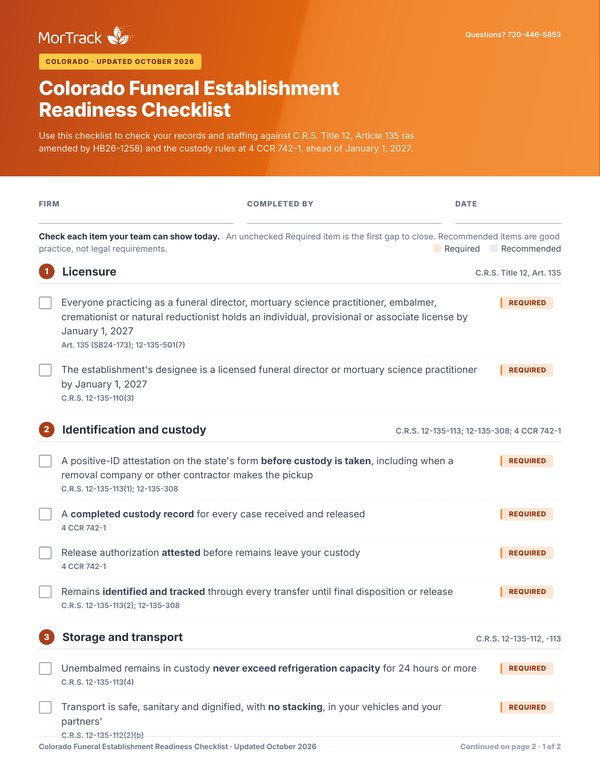

Colorado Funeral Establishment Readiness Checklist

PDF · 2 pages

Colorado Funeral Establishment Readiness Checklist

A quick way to see where you stand. Check what your firm has in place against Colorado’s requirements and the January 1, 2027 changes, with legal requirements and recommended practice clearly separated.

How MorTrack helps Colorado firms

Colorado expects every loved one to be positively identified before custody and tracked until final disposition or release, including when a contractor makes the pickup. MorTrack gives your team one simple way to document that journey as it happens, alongside the forms you already use.

MorTrack on desktop and mobile, showing a case being tracked from first custody to final disposition
  • Custody recorded the moment it happens

    Removal staff and drivers confirm custody from their phone at pickup and drop-off, even without a signal. The record starts when custody does, not hours later.

  • One record, every business

    A unique ID ties every movement, signature, form and personal effect to one case, and funeral homes, crematories, removal companies and trade services each record their part on it.

  • Know who’s in your care, and where

    A live dispatch board shows each loved one’s location, down to the room, shelf and refrigeration unit.

  • Ready for inspections and audits

    Pull body logs, cremation counts and the full custody chain for any case, whenever you need them.

MorTrack works alongside your case-management system. It helps support compliance readiness; it doesn’t replace Colorado’s required attestation and custody forms or guarantee compliance.

Book a 30-minute Colorado walkthrough

See how positive ID, handoffs and release records work in MorTrack, alongside Colorado’s requirements.

Questions? 720-446-5853

Frequently asked questions

No. The custody duty is already in force: positive identification, a completed custody record and attested release authorization have applied since the rules took effect in January 2025. The January 1 changes cover licensure, designees, the associate license and the abuse-of-a-corpse penalty.

C.R.S. 12-135-113; 4 CCR 742-1

Informational and educational only; reflects MorTrack’s reading of Colorado law (C.R.S. Title 12, Art. 135, as amended by SB24-173, HB24-1335 and HB26-1258; C.R.S. 18-13-101; 4 CCR 742-1) as of October 2026. Not legal advice. Laws, rules and enforcement change. MorTrack makes no warranty that this summary is complete or current, and use of MorTrack does not guarantee compliance with any law or regulation. Confirm requirements with the Colorado Division of Professions and Occupations or qualified legal counsel.

Last verified: October 2026