
CHAIN OF CUSTODY RESOURCE HUB · UPDATED OCTOBER 2026
Chain of custody requirements and resources for deathcare professionals.
What the law requires where you operate, cited to the statute and rule, plus free guides and checklists for your team.
Informational only; not legal advice.

Chain of custody resources by region.
Every state and province sets its own rules for the care and custody of the deceased, and they vary more than most people expect. We’ve researched the requirements across the US and Canada, and built plain-language guides and resources to help you understand what’s needed where you work.
Featured in-depth guides

Full custody tracking requirement
Illinois
Guide availableChain-of-custody rules for funeral establishments and crematories.
View Illinois →
Full custody tracking requirement
Colorado
Guide availableWhat’s required today, and what changes on January 1, 2027.
View Colorado →
Full custody tracking requirement
North Carolina
Guide availableTagging, transport permits and the 2026 changes to the funeral service law.
View North Carolina →Want a full guide for your state or province?
Tell us where you operate and we’ll email you when its guide is published.
Where every state and province stands
Chain-of-custody requirements fall into four broad levels. Here’s where each US state, DC and Canadian province or territory sits today.
- Full custody tracking requirement
- Crematory identification requirement
- Documentation requirements
- No custody-specific requirements
Full custody tracking requirement
4 placesThe law requires a system that identifies and tracks remains from custody through final disposition.
Crematory identification requirement
24 placesThe law requires an identification system for crematories, keeping identification with the remains through cremation.
Documentation requirements
31 placesRequired permits, records or identification at set points, without a continuous tracking mandate.
- Alberta
- British Columbia
- Connecticut
- District of Columbia
- Hawaii
- Idaho
- Indiana
- Kansas
- Kentucky
- Louisiana
- Maine
- Manitoba
- Massachusetts
- Michigan
- Mississippi
- Missouri
- Nebraska
- New Brunswick
- New Hampshire
- Newfoundland and Labrador
- Northwest Territories
- Nova Scotia
- Ontario
- Pennsylvania
- Quebec
- Rhode Island
- Saskatchewan
- South Carolina
- Washington
- Wyoming
- Yukon
How we research
Primary sources only: every requirement links to the statute, rule or regulator it comes from, and each page shows when it was last verified. We’ve researched all 50 states, DC and 13 Canadian provinces and territories; pages are published as each one is reviewed.
Dates to know
DEC 10, 2025
Illinois
In effect
Chain-of-custody rules take effect; electronic tracking expressly permitted.
OCT 1, 2026
North Carolina
In effect
Parts I–II of S.L. 2026-48 take effect, per the official bill summary.
NOV 30, 2026
Colorado
Upcoming
All funeral establishment registrations expire; renewal includes a liability insurance attestation.
JAN 1, 2027
Colorado
Upcoming
Individual licensure, licensed designees and a higher abuse-of-a-corpse penalty begin.
Free chain of custody resources
Practical guides to help your team understand chain of custody, spot where records commonly fall short, and see how documenting every handoff gives families the answers they deserve — and how MorTrack makes it simpler.

Free story
A Tale of Two Funeral Homes
Two similar firms handle the same chain of custody scenario with very different results. See what set them apart.
Read it →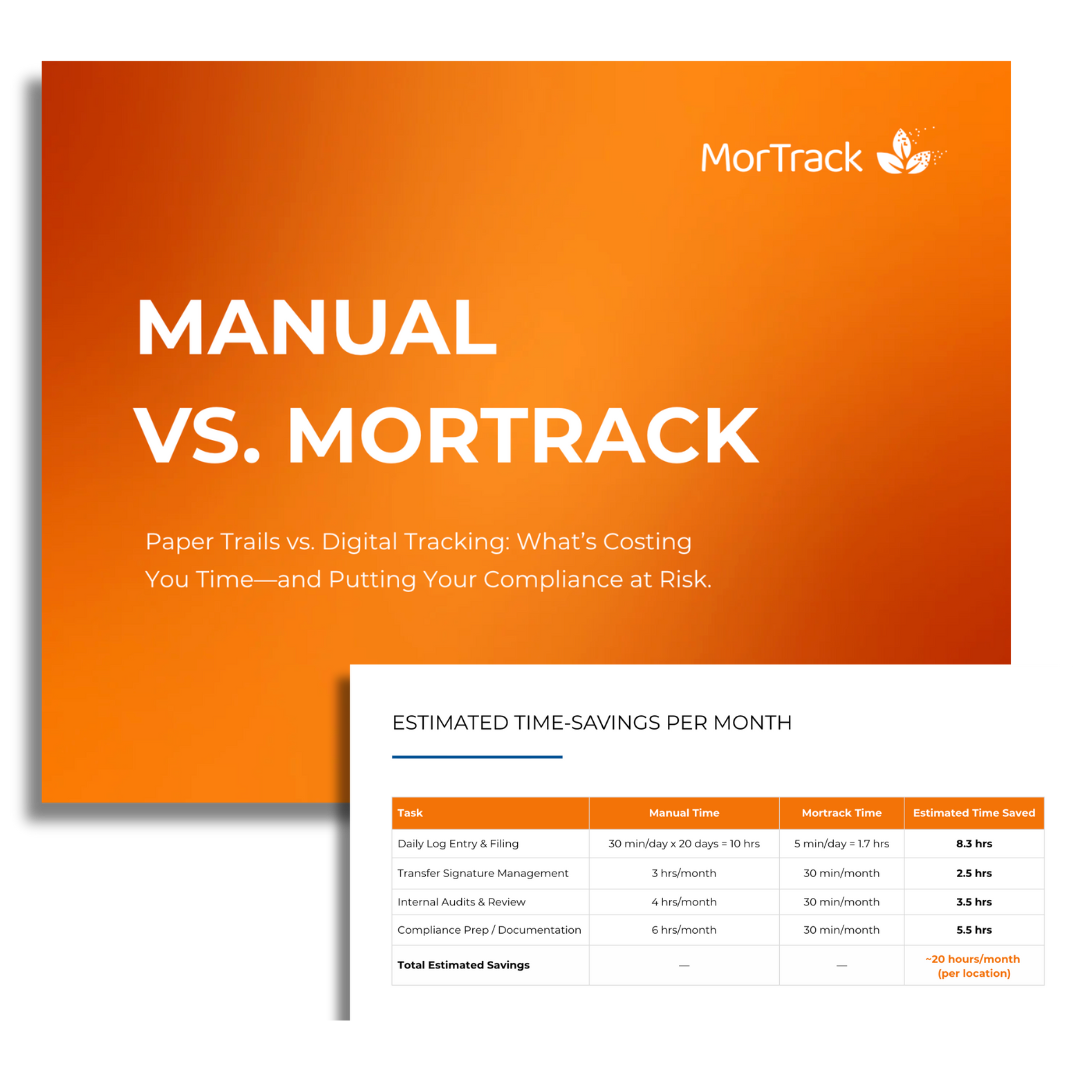
Free comparison sheet
Manual vs. MorTrack
A side-by-side look at how paper logs and spreadsheets slow your team down, and the 20-hour difference digital tracking makes.
Read it →See how MorTrack works where you operate
A 30-minute walkthrough of positive ID, handoffs and release records, mapped to your state’s requirements.
Questions? 720-446-5853Informational and educational only; not legal advice. Laws, rules and enforcement change; confirm requirements with your regulator or qualified counsel. MorTrack helps support compliance readiness and does not guarantee compliance with any law or regulation.